Showing posts with label Opinion. Show all posts

Monday, August 29, 2011

Bees Don’t Care About Your Stupid Physics


Article by, Gregory Lemberskiy

There exists a popular saying, “Scientists (physicists) believe that it is aerodynamically impossible for bees to fly”. My high school physics teacher cited it as an example of an unsolved problem in physics. It is often cited as proof that findings in physics are not absolute and should not be used to disprove evolution or the age of the earth. I guess you could say that they are supernatural “beeings”.

Where does this Saying Come From?
The saying originated from German technical institutes in the 1930s. Scientists from many different fields were invited to a dinner party. After a long night of “bier” and “schnitzel”, one biologist asked a physicist/aeronautics engineer about the flight of a bumblebee. At no point in the discussion was Nikolai Rimsky-Korsakov’s piece mentioned. The aeronautics engineer fumbled around with some calculations, but ultimately failed to prove that bees could fly. Everyone at the party laughed it up and began to spread the story around as an in-joke in academic institutions.

Other sources claim that French entomologist August Magnan and his assistant Andre Sainte-Langue were the first to claim that bees cannot fly, in 1934.

Wait, so Can Bees Fly?
Yes. Bees can fly and physicists can make approximations. In the 1930s, aeronautical engineers made planes with fixed wings and an engine or two. Approximating, the flight of bees using a fixed wing model is a brave, but foolish endeavor. In flight, bees utilize “lift” and “thrust” by constantly fluttering their wings. A better way to approximate this motion would be to compare it to the rotor of a helicopter. Unfortunately, the first helicopter was developed in 1936, so it is likely that our German friend did not have the tools needed for an appropriate approximation.

The question is much more complicated than it seems. In fact, vital details of their flight have been popping up in the last decade. One interesting discovery was made by Lijang Zeng of Tsinghua University analyzed bees and other insects through a parameter known as the “body vector”, using a laser system (Lijang Zeng et al 2001 Meas. Sci. Technol. 12 1886). The paper suggests that our German friend neglected the roughness, flexibility, and elasticity of bee wings.

The Bee Wing
Bees flap their wings in a 90 degree arc roughly 230 times a second. This frequency is extraordinarily fast for the bee’s modest size. Fruit flies, roughly 80 times smaller than bees, flap their wings 200 times a second. As creatures capable of flight grow in size, more energy is required to flap their wings. For example, birds flap their wings very slowly. They evolved feathers to overcome this limitation. Bee wings have another strange property. When the bee needs to carry a heavy load, such as pollen, it does not flap its wings faster. It increases its arc of rotation, but the rate at which its wings flutter remains the same. How do we explain this motion? Why are bees so special? The answer to this riddle is a super elastic material known as Resilin found on the tips of their wings. Resilin is made out of proline substituents. Proline is an imino acid, which has a massive 5-membered ring with a carboxylic acid functional group. The series of proline molecules forms this extensive series of U shaped molecules. Coupled together, these proline molecules can act as a “molecular spring”. This adaptation allows bees to flap/oscillate their wings at sufficient frequencies to overcome these classical barriers.

Resilin also explains why fleas can jump so damn high. The material literally compresses, storing energy, and then releases energy to accomplish inexplicably leaps with accelerations reaching 140G.

Tuesday, August 23, 2011

The Physics behind Earthquakes

Article by, Adrian Vatchinsky

To amend for the previous seasonally inappropriate snowflakes post, I figured I provide a more appropriate post this time around dealing with the physics behind earthquakes since basically the entire New York City shook along with the east coast today!

For starters, those who want to tackle the subject head on, I found this neat paper from CalTech which does a thorough job in giving a more rigorous background on earthquakes than the informal description which is about to follow.

For those who do not have the time (or patience) to read the 30+ paper allow me to take a stab at this fascinating event.

The reason behind earthquakes was not well understood until the tectonic plate revolution of the 1960s. It was actually in 1915 when Alfred Wegener first proposed the idea of continental drift as a way to explain the findings of similar fossils across lands separated by entire oceans. It took a while for this idea to become accepted and it was not until the 1960s that the concept of tectonic plates fully caught on.

But what exactly are tectonic plates? Well a really basic way of understanding what these "plates" are is to imagine the Earth as an egg drifting through space on its merry way, a space faring Humpty Dumpty if you will. And having the string of poor luck which the Dumpty family is notorious for, our poor space egg finds itself one day on a collision course with a rock floating in space. There is nothing that can be done to avoid this impact and the two bodies collide. The result is Humpty Dumpty's space cousin with a cracked shell!

The earth is sort of like that, the crust which we all live on top of is not one continuous solid. Instead it is subdivided among numerous "plates" which actively move around and interact with one another at their borders called fault lines.


Fig 1. A map of the Tectonic Plates which make up the Earth's crust.

But how does this all play into earthquakes you may wonder? Well as mentioned previously, these plates are in constant motion and interact with each other. For example the Pacific Plate and North American Plate are moving apart from one another, evident at the San Andreas Fault Line in California. Well, in the simplest terms, these plate interactions cause earthquakes!
Take a look at the following figure which shows areas of earthquake activity.

Fig 2. A map of earthquake activities

If you look at Fig 1 and Fig 2 you can kind of see that the earthquakes align with the plate boundaries in a sense. These interactions which occur (slipping, sliding, pushing) are not immediately noticed but instead build up elastic strain energy within the system. Eventually this form of potential energy becomes too great to bear and the rocks "slip" in a sudden fast motion. The location of the fault where this slip occurs is called the hypocenter from which seismic waves propagate throughout the surrounding area.

These waves, much like any other wave travel along their median, the earth, and cause displacements to occur along that medium. These are the waves people tend to feel during an earthquake.

Fig 3. Simple representation of an earthquake

As these waves travel they lose their energy with distance. Depending on the strength of the earthquake the waves propagate near or far from the hypocenter.

The reason why so many people were surprised today as they felt the residual waves of the Virginia earthquake was because there really are no major fault lines on the east coast to cause major earthquakes. This just goes along the point raised in the paper I initially cited which states that even today earthquake causes are not completely understood and the explanation is not as simple as two plates colliding.

In any case for those who are interested in a more detailed explanation I urge them to look it up.

In conclusion, I will leave with this video showing a simulation of an earthquake hitting a major city area.


Tuesday, August 16, 2011

Words of Wisdom from a Tornado

Article by, Adrian Vatchinsky

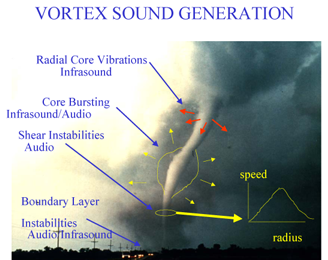
Tornadoes have ravaged the continental United States year after year as they await the right conditions to allow for their formation. What these conditions exactly are, is still up for debate as scientists still face difficulties in coming up with ways to confidently predict and expect tornado formations. However, an interesting observation from tornado formations - a low infrasound frequency - may allow us to develop more advanced last minute warning systems (1).

The average human can hear sound in the frequency range of 20 Hz to 20kHz. Infrasound is sound waves below the 20Hz mark. Near-infrasound is sound in the range of 1Hz to 20Hz and infrasound is in the range of 0.05Hz to 1 Hz. This is akin to how light outside of the visible spectrum is called near-infrared and infrared.

It has been observed that various events, such as explosions, avalanches, storms, produce infrasound waves. These waves, due to their low frequency have very long wavelengths and thus are capable of traveling long distances. Infrasound monitoring has been successfully used as a last-minute warning system for avalanches (2) and also as a monitoring system for nuclear testing (3). Infrasound monitoring systems are also of interest as a warning and tracking system for tornadoes. It is also possible to infer the diameter of a tornado from the fundamental frequency it produces giving us a better idea of the scale this tornado falls under (4).


A violent rotating column of air which has made contact with the ground is a simple way of describing what a tornado is. The formation of this column of air results from the right combination of wind directions, storm conditions, and relative humidity and temperature in the surroundings. These conditions are most favorable to occur during a thunderstorm.

If warm moist air is to be found near the ground and a block of cold dry air moves overhead, the lighter warmer air will move up due to an updraft caused by this new arrangement of air blocks. As the warm air moves along with the updraft it may encounter wind shear. An example of wind shear would be wind near the ground traveling at about 5mph southeast, but then wind about 5000 feet up is blowing at 25mph southwest (5). The wind shear will cause the warm updraft to begin rotating on its way up. This rotation creates a mesocyclone – an area of organized rotation a few kilometers up in the atmosphere, typically 2-10 km across. Mesocyclones are detectable by DOPPLER radar. Once a mesocyclone forms, the thunderstorm is classified as a supercell. As rainfall increases, a downdraft in the storm may occur which is called the rear flank downdraft (RFD). The RFD may bring the mesocyclone down forming a visible condensation funnel at the base of the supercell narrowing the mesocyclone. Once this mesocyclone makes contact with the ground the storm is classified as a tornado.

For tornado enthusiasts, check out the Tornado History Project which is an excellent online database which has a wide range on information on basically all reported tornadoes in the United States.

Image credit goes to Wikipedia.


Monday, August 15, 2011

Opinion

The Opinion label will contain mainly editorial-style pieces and will overall be more informal than the rest of the content.

Here is also the section where members can write about research they are doing or more original-style articles.