Showing posts with label News. Show all posts

Tuesday, November 8, 2011

A Spiral Star


Recently researchers using the Subaru telescope in Hawaii have found a star with spiral arms. What is that you may be wondering, well if you notice the picture above the star consits of a central star, much like our Sun or any other star, but this particular case has spiral arms!

The star is formally called SAO 206462 and is located in the constellation Lupus and only about four hundred light years away from Earth. This discover is a first for spiral stars. Prior to this researches knew of exotic looking stars, from dwarf stars, giant stars, dead stars, binary stars, and exploding stars, but never any spiral stars.

Granted the millions of stars already catalouged, it is surprising to find such an exotic case so close to Earth. This leads us to wonder what else is out there.

For full story check out the link from NASA

Monday, November 7, 2011

Brave Mars Explorers Return to Earth from Earth

Above is a depiction of the environment in which the ESA members lived for 520 days.

Link to Story

On Novermber 4th, 2011, six brave men emerged from a capsule in which they had been sealed for a year and a half in an effor to simulate a real Mars expedition. The goal of the program was to see how the human can physically and mentally survive the long journey to Mars.

The experiment was carried out by a crew of six European Space Agency members at the Institute of Biomedical Problems in Moscow, Russia.

The crew lived on for a full 520 days in a fully self sustained environment and even simulated putting on space suites and a landing on the surface of Mars.

Would you go through with such an experiment, locking yourself in a vault for a fill year and a half?

Thursday, October 6, 2011

The Ig Nobel Prizes

So everyone is talking about the Nobel Prizes lately, so I figured I bring up a ceremony just as important in my humble opinion, and that is the Ig Nobel Awards for Improbable Research!

Check it out here

Winners in physics:

2011
PHYSICS PRIZEPhilippe Perrin, Cyril Perrot, Dominique Deviterne and Bruno Ragaru (of FRANCE), and Herman Kingma (of THE NETHERLANDS), for determining why discus throwers become dizzy, and why hammer throwers don't.
REFERENCE: "Dizziness in Discus Throwers is Related to Motion Sickness Generated While Spinning," Philippe Perrin, Cyril Perrot, Dominique Deviterne, Bruno Ragaru and Herman Kingma, Acta Oto-laryngologica, vol. 120, no. 3, March 2000, pp. 390–5.
ATTENDING THE CEREMONY: The winners accepted via recorded video.

2010
PHYSICS PRIZELianne ParkinSheila Williams, and Patricia Priest of the University of Otago, New Zealand, for demonstrating that, on icy footpaths in wintertime, people slip and fall less often if they wear socks on the outside of their shoes.
REFERENCE: "Preventing Winter Falls: A Randomised Controlled Trial of a Novel Intervention," Lianne Parkin, Sheila Williams, and Patricia Priest, New Zealand Medical Journal. vol. 122, no, 1298, July 3, 2009, pp. 31-8.
WHO ATTENDED THE CEREMONY: Lianne Parkin

2009
PHYSICS PRIZEKatherine K. Whitcome of the University of Cincinnati, USA, Daniel E. Lieberman of Harvard University, USA, and Liza J. Shapiro of the University of Texas, USA, for analytically determining why pregnant women don't tip over.
REFERENCE: "Fetal Load and the Evolution of Lumbar Lordosis in Bipedal Hominins," Katherine K. Whitcome, Liza J. Shapiro & Daniel E. Lieberman, Nature, vol. 450, 1075-1078 (December 13, 2007). DOI:10.1038/nature06342.
WHO ATTENDED THE CEREMONY: Katherine Whitcome and Daniel Lieberman

And so forth...feel free to browse it!

Friday, September 23, 2011

Reconstructing your brain's image

Article by, Adrian Vatchinsky


Neurologists at UC Berkley appear to have devised a way to depict what our brain sees! If you look at the video above, you will notice the left side consists of one of the theatrical trailers shown to test subjects and the right side represents the brain reconstruction of it. The way the process works is by analyzing brain activity during the duration of the exposure to the visual cues. This information is stored in a voxel-system which then starts getting compared to hundreds of youtube videos around the web. This second video below better shows the process.
The resulting image may be somewhat blurry but it is amazing none the less and a great first step in just figuring out what we dreamt about!


Source

(Thanks Lindsay for showing me this!)

Thursday, September 22, 2011

Faster than light particles?


A few researches working with CERN have reported on finding particles that travel faster than light. Now, before you get all excited and prepare to forget everything you learned about physics bare in mind that the time difference measured is extremely small and reproductions of the results are still awaited. 

Anyways check out the source!

(Thanks Abhi for showing me this!)

Friday, September 9, 2011

A Picture is Worth a Thousand Words

Article by, Adrian Vatchinsky

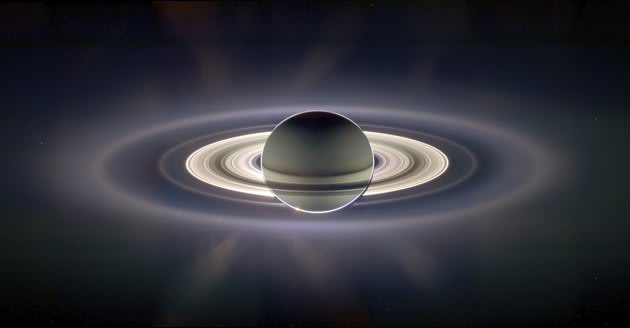
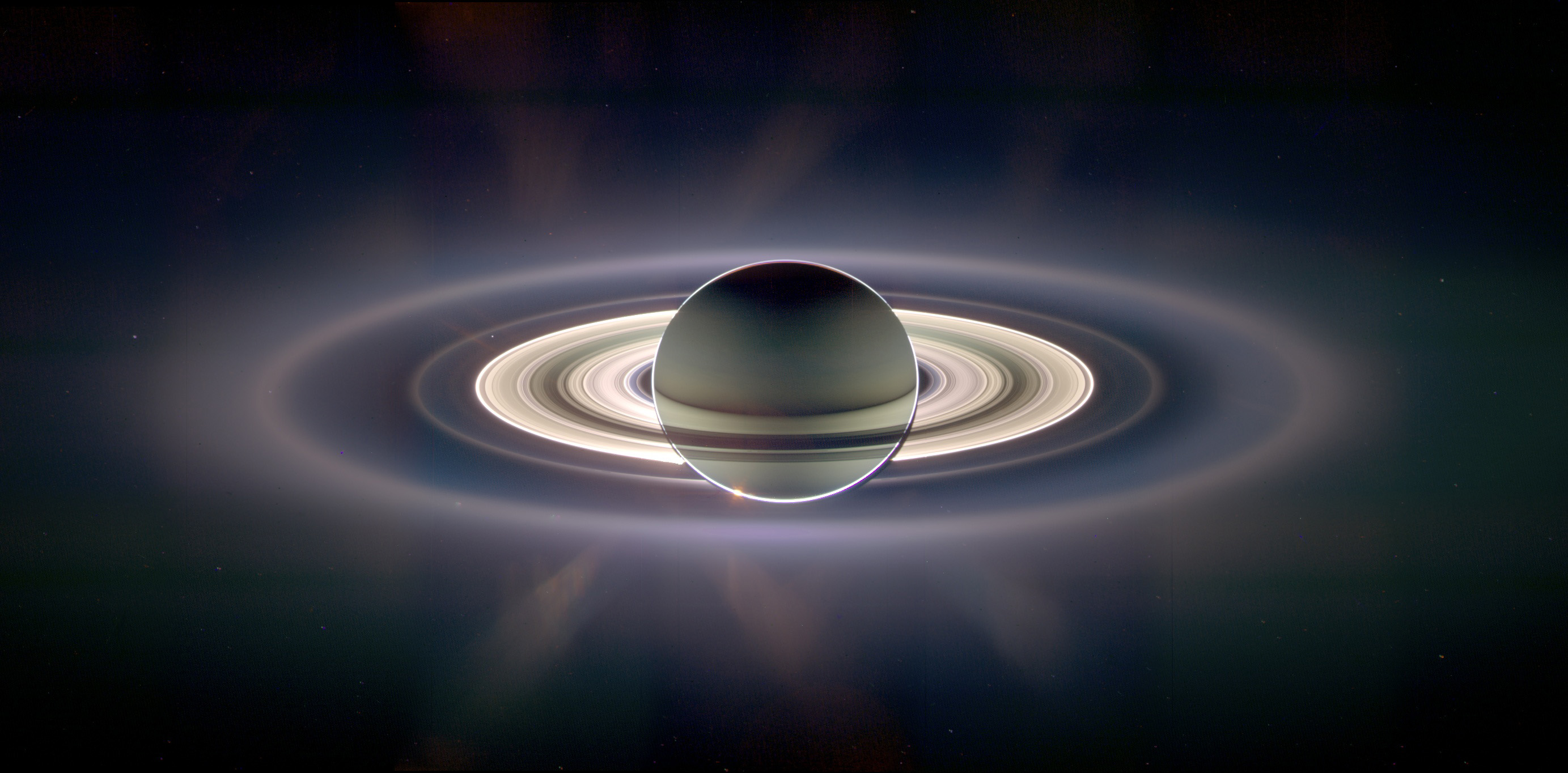
Sometimes a picture really is worth a thousand words. NASA has recently released pictures from the Cassini probe which in my humble opinion are truly breathtaking. I will let you all just take a look, and check this apod link out for the high res pic!


An even more interesting video I came across however takes images like the one above and actually puts together a "fly by" film of the Cassini spacecraft. Knowing that these are real images, not animations or models, really speaks for the beauty found around us!


Looking into the eye of the storm

Article by, Adrian Vatchinsky

Image from NASA
Evidence for a pair of supermassive black holes in a spiral galaxy has been found in data from NASA's Chandra X-ray Observatory. This main image is a composite of X-rays from Chandra (blue) and optical data from the Hubble Space Telescope (gold) of the spiral galaxy NGC 3393. Meanwhile, the inset box shows the central region of NGC 3993 as observed just by Chandra.

The diffuse blue emission in the large image is from hot gas near the center of NGC 3393 and shows low energy X-rays. The inset shows only high energy X-rays, including emission from iron. This type of emission is a characteristic feature of growing black holes that are heavily obscured by dust and gas.

Two separate peaks of X-ray emission (roughly at 11 o'clock and 4 o'clock) can clearly be seen in the inset box. These two sources are black holes that are actively growing, generating X-ray emission as gas falls towards the black holes and becomes hotter. The obscured regions around both black holes block the copious amounts of optical and ultraviolet light produced by infalling material.

At a distance of 160 million light years, NGC 3393 contains the nearest known pair of supermassive black holes. It is also the first time a pair of black holes has been found in a spiral galaxy like our Milky Way. Separated by only 490 light years, the black holes in NGC 3393 are likely the remnant of a merger of two galaxies of unequal mass a billion or more years ago.

Dubbed "minor mergers" by scientists, such collisions of one larger and another smaller galaxy may, in fact, be the most common way for black hole pairs to form. Until the latest Chandra observations of NGC 3393, however, it has has been difficult to find good candidates for minor mergers because the merged galaxy is expected to look like an ordinary spiral galaxy.

If this was a minor merger, the black hole in the smaller galaxy should have had a smaller mass than the other black hole before their host galaxies started to collide. Good estimates of the masses of both black holes are not yet available to test this idea, although the observations do show that both black holes are more massive than about a million Suns. 
Follow the link for the full article!

Wednesday, September 7, 2011

Garbage from above!!


Article by, Adrian Vatchinsky

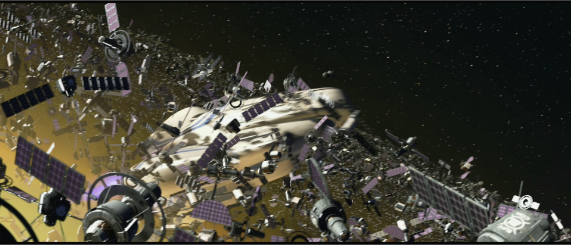
You better be on the lookout one of these nights in late September/early October for a large 6.5 ton satellite which I hear if you make a wish to, it will come true. Well NASA has today stated that the huge Upper Atmosphere Research Satellite is coming at the end of its earth revolving days and is on a re-entry path back into Earth. 

The incoming debris does pose concern however as orbital real estate is becoming very cluttered with the sudden increase in orbital crafts within the last decades or so. The NASA has stated that it will be taking actions to help inform the public of the possibility of any incoming debris so hopefully no one will wake up with a giant solar panel crashing through their ceilings!

Follow the link for more details on the story!

What do you think about the increasing problem of orbital debris? Will the world of Wall-E ever come true? Sound off in the comments below!

Thursday, September 1, 2011

Benjamin Button's Star


Article by, Adrian Vatchinsky

How curious would it be to find a star which shows signs of great aging and yet also appears relatively young? The star, cleverly called SDSS J102915+172927, is a curious case discovered by Lorenzo Monaco of the European Southern Observatory in Chile, which shows both signs of old age and youth at the same time.

The low concentrations of elements heavier than Helium within the star are signs that the star is relatively young. As a brisk refresher, a star can be grossly oversimplified as a sphere of hot gas held in balance by a delicate tug of war battle between gravity and pressure forces. Nuclear Fusion is the process which powers the great engines of stars, and in simplest terms the process involves taking two light elements and combining them to create a heavier element.

As such young stars start out as gas balls filled mainly with hydrogen and helium - the most abundant elements in the universe - and through the process of nuclear fusion they great heavier and heavier elements within their cores until the "fuel" can no longer efficiently run undergo the process.

The low concentration of chemical elements heavier than hydrogen and helium suggests it is the most primitive star ever discovered, yet the exact ratio of these heavier elements suggests it is much younger.

Possible explanations include the cooling of the star nursery. If the star was cooled by interstellar dust or some other means that could explain the odd ratios of elements yet youthful star.

Hopefully now that the southern hemisphere sky is starting to open up as scientists construct more and more observatories in the region we will be able to find out many more interesting cases such as SDSS J102915+172927.

Hit the source for the full story.

Tuesday, August 30, 2011

Black Hole Devours Star

Article by, Adrian Vatchinsky
What an sight it must be to witness a black hole devouring a star. Something as massive, if not even grander than our own fair star being sucked into a cosmic singularity undergoing all sorts of time dilations and length contractions.

Well recently scientists have been able to get an accurate representation of what this process is like. Check out the video and follow the link for the full story!


Sunday, August 21, 2011

Snowflakes Guide

Article by, Adrian Vatchinsky

So I figured since Fall semester is around the corner what way to better get in the mood for the upcoming freeze fest that is NYC during winter then post a guide about snowflakes! (Well ok, I will admit I may be a bit premature with this one...)

In any case, here is a quick primer from CalTech on what snowflakes are, the physics behind them, and well probably more information than anyone should know regarding snowflakes!


Monday, August 15, 2011

Living on a Chunk of Coal


Article by, Adrian Vatchinsky

National Geographics recently reported on an exoplanet that just had what it takes to stand out amongst the now hundreds of exoplanets discovered in the last few years.

Before you get your hopes up that this planet is the long lost twin of Earth, it should be noted that the temperatures on this planet are assumed to reach about 980 C, which can more than fry an egg. What makes this planet so interesting is that it is extremely dark. In fact, a lump of charcoal reflects more light than this Jupiter-sized planet!

The planet was discovered by the Keplar Space Telescope which is specifically designed with the goal of finding exoplanets across the Universe. The way the Keplar telescope detects these minuscule specs out in space it by focusing its sensors on an area of the sky. It then looks for any dimming or changes in the incoming light from the stars. A possible reason as to why such a dimming occurred could be, if all things aligned properly, that a planet passed in between the star and our eye in the sky. When it came to this particular planet, there was a change in relative brightness of the host star of only 6.5 parts per million!

Other tests to detect exoplanets include detecting small wobbles in stars which could be due to planets' gravitational pull on their stars.

Even though this planet may not be the blue jug of water we have been searching for it is nonetheless a testament to the accuracy and engineering of our latest attempt at probing the night skies!

Follow the link for the article

News Outline

Under the news label you will find posts about interesting news and stories we have found on the web or heard about.